Insights on participation and digital democracy
A curated set of key guides first, followed by the full archive to explore topics, case studies, and tools.
Featured articles
Our most read and recently updated guides—start here to build a solid foundation on digital democracy and participation.

From the Greek polis to civic tech: evolution of participation
Introduction Participation in collective decision-making is one of the foundational questions in the history of Western…
What is Digital Democracy and Why it Matters Today
Introduction Over the past decades, contemporary democracies have entered a phase of profound structural transformation. The…

Digital Participatory Budgeting: A Complete Guide for Municipalities and Organizations
Participatory budgeting works when residents can see trade‑offs, track proposals and verify delivery. This digital toolkit covers eligibility, idea intake, clustering, cost verification, voting and post‑vote tracking. We include accessibility tips, anti‑fraud safeguards and guidance to publish datasets/APIs for civic monitoring. A sample calendar and lightweight RACI align teams across departments and vendors, turning one‑off votes into ongoing collaboration.

The Future of Shared Property Governance
Introduction Across the world, millions of people live in common-interest communities (CICs): condominium associations, homeowners associations…

The principles of collaborative democracy
Introduction Collaborative democracy represents one of the most significant evolutions in contemporary democratic thought. It does…
All articles
Explore our articles on participation and digital democracy: insights, case studies, and practical guides on online platforms, civic engagement, and collaborative decision-making for communities, institutions, and citizens.
From the Greek polis to civic tech: evolution of participation
Introduction Participation in collective decision-making is one of the foundational questions in the history of Western…
What is Digital Democracy and Why it Matters Today
Introduction Over the past decades, contemporary democracies have entered a phase of profound structural transformation. The…
Digital Participatory Budgeting: A Complete Guide for Municipalities and Organizations
Participatory budgeting works when residents can see trade‑offs, track proposals and verify delivery. This digital toolkit covers eligibility, idea intake, clustering, cost verification, voting and post‑vote tracking. We include accessibility tips, anti‑fraud safeguards and guidance to publish datasets/APIs for civic monitoring. A sample calendar and lightweight RACI align teams across departments and vendors, turning one‑off votes into ongoing collaboration.
The Future of Shared Property Governance
Introduction Across the world, millions of people live in common-interest communities (CICs): condominium associations, homeowners associations…
The principles of collaborative democracy
Introduction Collaborative democracy represents one of the most significant evolutions in contemporary democratic thought. It does…

Crisis tables: a facilitation playbook for fast, legitimate decisions
When time is scarce, process quality matters. This playbook lays out structure and rules for crisis tables: stakeholder engagement, fact-centered agendas, coordination and facilitation roles, timing, consent checks and fallback options. It includes techniques for fast synthesis, conflict handling and public communication—speed without losing legitimacy.

Open data for participation: public dashboards that matter
Public dashboards only help participation when they are readable and up to date. We outline data governance and design: clear goals, minimal metrics, refresh cadence and accountability. Learn how to integrate heterogeneous sources with traceability, publish datasets and metadata, and communicate limits and revisions. Simple layouts help residents and agencies track proposals, timing, budgets and delivery—turning open data into trust.

Civic tech: lean KPIs for legitimacy and delivery
Many civic‑tech projects fade after launch because success criteria are vague. We propose a lean KPI set: reach, inclusion, participation quality, decision impact and delivery. Learn how to capture each metric with privacy‑respecting analytics, surveys and open data, and how to publish dashboards residents can actually read. Link metrics to product and policy changes with examples from cities, schools and associations.

Online consultations: inclusive moderation that builds trust
Online consultations can amplify voices—or conflict. We outline moderation practices that increase inclusion and legitimacy: clear codes of conduct, pre‑moderation for sensitive topics, transparent escalation and accessible summaries. Checklists help recruit diverse facilitators, handle AI‑generated content and prevent harassment. We show how to cluster ideas without bias and how to demonstrate impact with regular feedback.

Company decisions: consent, advice process and traceability
Teams need speed without losing legitimacy. We compare majority voting, consent and the advice process: when each fits, how to combine them, and how to document choices with roles and traceability. You’ll get proposal templates, feedback loops and escalation paths, plus “good‑enough‑for‑now, safe‑to‑try” experiments. Simple metrics—cycle time, decision quality, inclusion—help continuous learning and compliance.

Condominiums 2025: guidelines for transparent hybrid meetings
Hybrid homeowner meetings are no longer a workaround—they’re a reliable way to cut conflict and speed up decisions. This 2025 playbook covers accessible notices, tracked proxies, speaker sign‑ups and agenda design that focuses on solutions. Learn how to compare quotes transparently, record decisions with verifiable minutes and keep residents informed about budgets and delivery. A lightweight digital toolkit helps property managers ensure inclusion, data protection and clear voting rules, reducing disputes while improving shared spaces.

Airport expansions and regional planning: a participatory approach (Florence–Pisa)
Expanding airports means long‑term choices on accessibility, noise, land use and regional governance—the Florence–Pisa system is a telling case. We compare scenarios and suggest an inter‑municipal governance to decide on mitigations and benefit‑sharing. The guide helps evaluate alternatives with territorial coherence, robust evidence and time‑bound commitments. The guide details institutional and civic roles, evidence handling, tools to safeguard fairness and transparency, and how to translate outcomes into time‑bound, enforceable conditions. It includes examples, call and agenda templates, minutes models, operational checklists and quality indicators, plus guidance for clear communication, transparent timelines and the inclusion of vulnerable groups. Based on the Concorder proposal: airport expansions and regional planning a participatory approach florence pisa.

Citywide 30 km/h limits: balancing safety, flow and acceptance (Bologna)
Citywide 30 km/h limits sit at the intersection of safety, traffic flow and social acceptance—and Bologna offers timely insights. We outline a path that uses open data, structured listening and targeted adjustments to calibrate the perimeter and carve‑outs. The approach aims to lock‑in benefits while protecting vulnerable users, businesses and environmental goals. The guide details institutional and civic roles, evidence handling, tools to safeguard fairness and transparency, and how to translate outcomes into time‑bound, enforceable conditions. It includes examples, call and agenda templates, minutes models, operational checklists and quality indicators, plus guidance for clear communication, transparent timelines and the inclusion of vulnerable groups. Based on the Concorder proposal: citywide 30 km h limits balancing safety flow and acceptance bologna.

Transit megaprojects and communities: a participatory playbook from Florence
Florence’s tramway works affect traffic, local businesses and the quality of public space every day. We suggest neighborhood tables, targeted support, street‑safety measures and clear communication on phases, detours and timing. Playbook templates help monitor conflicts, set local priorities and co‑govern the project with shared responsibility. The guide details institutional and civic roles, evidence handling, tools to safeguard fairness and transparency, and how to translate outcomes into time‑bound, enforceable conditions. It includes examples, call and agenda templates, minutes models, operational checklists and quality indicators, plus guidance for clear communication, transparent timelines and the inclusion of vulnerable groups. Based on the Concorder proposal: transit megaprojects and communities a participatory playbook from florence.

Stadium redevelopment and public value: a participatory decision framework (Milan case)
Deciding on stadium futures requires a public assessment of alternatives, costs and benefits, heritage safeguards and construction impacts. We provide a method to weigh demolition, conservation and redevelopment scenarios with public criteria and collective‑value indicators. The framework integrates community benefits and business support, accessibility, non‑sport uses and protection of the Meazza’s civic memory. The guide details institutional and civic roles, evidence handling, tools to safeguard fairness and transparency, and how to translate outcomes into time‑bound, enforceable conditions. It includes examples, call and agenda templates, minutes models, operational checklists and quality indicators, plus guidance for clear communication, transparent timelines and the inclusion of vulnerable groups. Based on the Concorder proposal: stadium redevelopment and public value a participatory decision framework milan case.
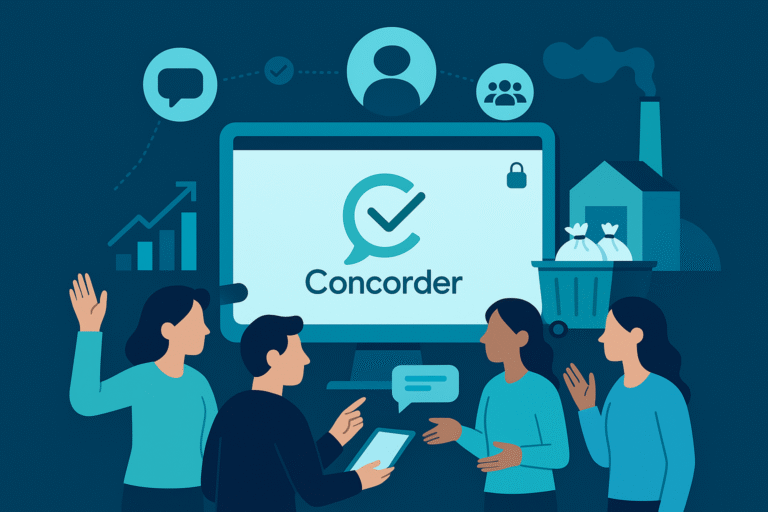
Santa Palomba waste-to-energy: designing a fair public inquiry
A credible public inquiry on Rome’s Santa Palomba plant needs a shared purpose, a clear scope and transparent ground rules. We propose a four‑phase sequence—preparation, listening, public debate, and delivery—with realistic tools and timelines. Special focus is given to air and water impacts, road and rail logistics, the actor map and the prioritization of mitigations and trade‑offs. The guide details institutional and civic roles, evidence handling, tools to safeguard fairness and transparency, and how to translate outcomes into time‑bound, enforceable conditions. It includes examples, call and agenda templates, minutes models, operational checklists and quality indicators, plus guidance for clear communication, transparent timelines and the inclusion of vulnerable groups. Based on the Concorder proposal: santa palomba waste to energy designing a fair public inquiry.

Collective Intelligence and AI: How to Make Better Decisions Through Structured Participation
Introduction When we talk about collective intelligence we are not invoking an abstract slogan, but a…