

Introduction
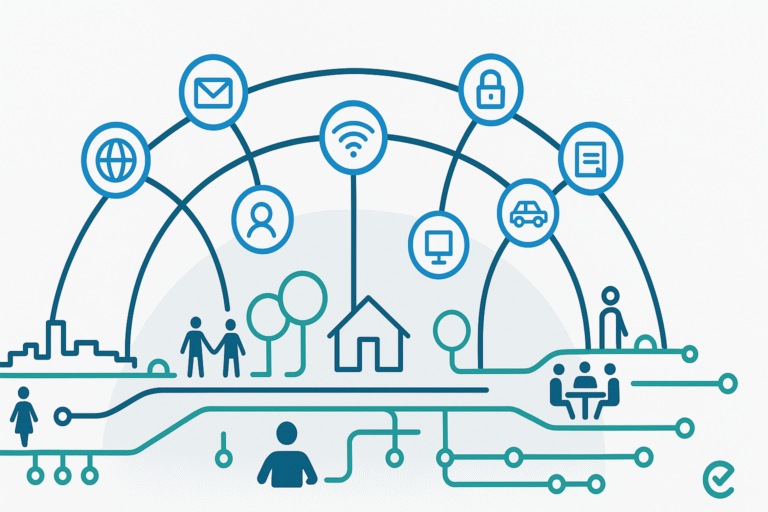
Collaborative democracy represents one of the most significant evolutions in contemporary democratic thought. It does not merely expand participation; it redefines how collective decisions are constructed, justified, and legitimized. In a context marked by increasing social complexity, institutional distrust, and polarization, collaboration is not simply a normative ideal—it is a structural condition for better decision-making.
The widely discussed “crisis of representation” does not imply abandoning representative democracy. Rather, it highlights the need to integrate it with processes capable of strengthening transparency, inclusion, and accountability. This is precisely where collaborative democracy finds its role.
Historically, this evolution can be traced from the deliberative practices of the ancient polis to modern civic technology ecosystems. The continuity between classical deliberation and digital participation infrastructures is explored in From the Greek Polis to Civic Tech.
From Representative Democracy to Structured Collaboration
Modern representative democracy is grounded in a fundamental principle: citizens elect representatives who make decisions on their behalf. For centuries, this model has ensured stability and governability. However, the growing complexity of regulatory, economic, and technological systems has revealed a limitation: the distance between decision-makers and citizens can weaken perceived legitimacy.
Collaborative democracy does not replace representation. Instead, it complements it through structured deliberative processes. Legitimacy derives not only from the final vote but from the pathway leading to that decision: quality information, plural perspectives, regulated dialogue, and procedural transparency.
The OECD has documented how well-designed deliberative processes lead to more robust and implementable public policies, reducing post-decision conflict and increasing institutional trust.
Theoretical Foundations: Deliberation and the Public Sphere
The intellectual roots of collaborative democracy lie in deliberative democratic theory. Jürgen Habermas argued that democratic legitimacy emerges from rational-critical debate within the public sphere. Decisions are legitimate when they can be justified through inclusive and reasoned discourse.
James Fishkin’s experiments with deliberative polling empirically demonstrated that citizens who receive balanced information and engage in structured dialogue often revise their initial opinions toward more nuanced and less polarized positions. This phenomenon—known as deliberative opinion change—highlights the cognitive value of informed discussion.
In this sense, collaboration is not only normative but epistemic: it improves the quality of collective knowledge upon which decisions are based.
Collaborative Democracy and Technology
Digital technology did not create collaborative democracy, but it has dramatically expanded its operational capacity. Digital platforms enable:
- Traceable proposals and amendments
- Asynchronous participation
- Public archiving of arguments
- Reduction of informational asymmetries
The United Nations’ E-Participation Index measures the extent to which governments integrate digital tools into participatory processes. Countries scoring highly tend to show stronger integration between digital infrastructure and civic engagement.
The European Commission, through its Digital Principles, explicitly recognizes citizens’ rights to participate in democratic life via secure and accessible digital tools—further institutionalizing participation as a structural dimension of governance.
Documented Structural Benefits
Comparative research identifies several recurring benefits of collaborative democratic processes:
- Procedural legitimacy: decisions are perceived as fairer when the process is transparent.
- Higher policy quality: diverse inputs reduce blind spots and systemic errors.
- Reduced polarization: structured dialogue moderates extreme positions.
- Strengthened civic capital: collaboration fosters trust and mutual understanding.
The Council of Europe emphasizes that meaningful citizen participation enhances democratic resilience, particularly in contexts of rapid technological and social change.
Participatory, Deliberative, and Collaborative Democracy: Key Distinctions
Although often used interchangeably, participatory, deliberative, and collaborative democracy refer to distinct conceptual layers.
Participatory democracy focuses on expanding citizen involvement. Its core concern is access: the more people participate, the stronger the democratic mandate.
Deliberative democracy emphasizes the quality of discussion. Participation must involve structured argumentation and informed reasoning.
Collaborative democracy integrates both dimensions and adds a further element: co-production of solutions. Citizens are not merely consulted; they contribute to designing outcomes.
This distinction becomes crucial in complex policy domains where binary choices are insufficient and multi-dimensional problem-solving is required.
The Epistemic Value of Collaboration
An often overlooked dimension of collaborative democracy is its epistemological function. How do societies generate reliable collective knowledge?
Research in political theory and decision science suggests that diverse groups operating within structured frameworks often outperform homogeneous or unstructured ones. Diversity mitigates cognitive bias and expands the range of considered alternatives.
Collaborative processes, when properly designed, function as collective intelligence systems. Transparency, traceability, and open argumentation increase the likelihood of well-informed decisions.
Limits and Risks
No democratic model is without challenges. Collaborative democracy must confront potential risks:
- Tokenistic participation: processes that simulate inclusion without real impact.
- Information overload: excessive complexity discourages engagement.
- Digital divide: unequal access to digital tools may reproduce inequalities.
- Online polarization: without moderation, digital spaces can amplify conflict.
Technology alone cannot resolve these issues. Institutional design, moderation, and clear procedural rules remain essential.
International Experiences and Future Trajectories
Several international experiences illustrate converging trajectories. Beyond Europe, countries such as Canada and Taiwan have experimented with national-scale digital deliberation. Taiwan, in particular, has integrated online deliberation platforms into formal policy-making processes, demonstrating that structured digital dialogue can help resolve highly polarized issues.
Successful models typically share three elements:
- Transparent and documented processes
- Integration with formal decision-making institutions
- Mandatory public feedback mechanisms
These features suggest that collaborative democracy is evolving from experimental innovation to institutional standard.
Conclusion
Collaborative democracy represents a structural response to contemporary complexity. It integrates representation, deliberation, and digital innovation into a model that strengthens legitimacy and decision quality. It does not replace voting—it enriches it.
👉 To explore how these principles can be translated into structured digital processes, discover all the features on Concorder or book a free demo.
Sources
- OECD – Innovative Citizen Participation and New Democratic Institutions
- United Nations – E-Participation Index
- Council of Europe – Recommendation CM/Rec(2018)4
- European Commission – European Digital Rights and Principles
- Fishkin, J. (2018). Democracy When the People Are Thinking.
- Habermas, J. (1996). Between Facts and Norms.