
Introduction
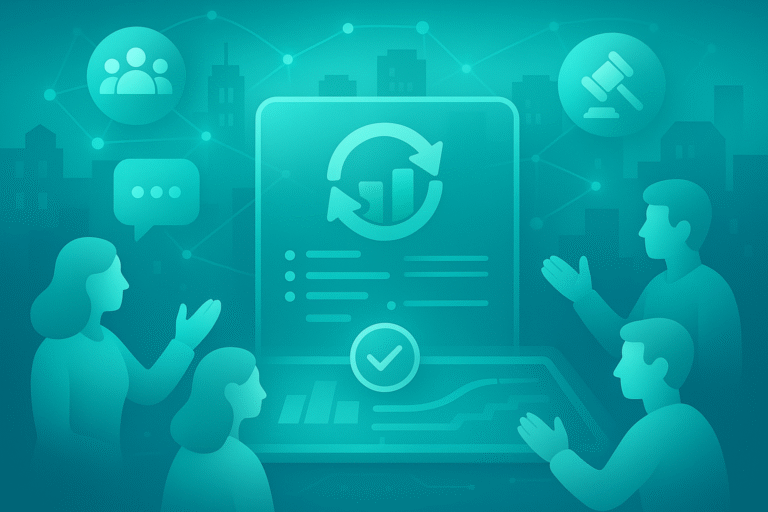
Many companies still make decisions through endless meetings, chaotic chats, and email threads that blur roles and responsibilities. Yet the strength of an organization lies in its ability to decide together. Participatory companies turn dispersed ideas into structured, shared, and traceable choices — reducing delays, increasing commitment, and building a culture of mutual trust.
This shift is cultural before it is technological. As explored in Civic innovation: how technologies rebuild public trust, participation is not just an ethical stance — it is a competitive advantage. Today, platforms like Concorder bring deliberative methods into everyday business, helping teams move from brainstorming to measurable, accountable decisions.
Why adopt participatory governance at work
From hierarchy to distributed involvement
Rigid structures struggle in fast, interconnected markets. Participatory governance activates internal skills across departments, turning “opinions” into evidence-based input. As discussed in Digital participation: how to truly engage citizens, transparent processes and traceable contributions raise the quality of decisions and reduce organizational friction.
External research also highlights the productivity upside of combining AI and collaboration. Analyses reported by the Europe Commission outline efficiency gains and risk areas, reminding leaders that technology must be governed by clear rules of use and accountability.
From consensus to shared outcomes
The goal is not a generic agreement but informed, measurable outcomes. Three pillars support participatory governance in companies:
- Role clarity: each proposal has a sponsor, reviewers, and approvers.
- Process transparency: decision steps are visible and documented.
- Organizational memory: every choice leaves a trace and becomes shared knowledge.
Teams that co-create decisions show higher motivation and stronger ownership, turning execution into a natural continuation of deliberation.
Concorder for companies: from ideas to traceable decisions
Create groups and proposals
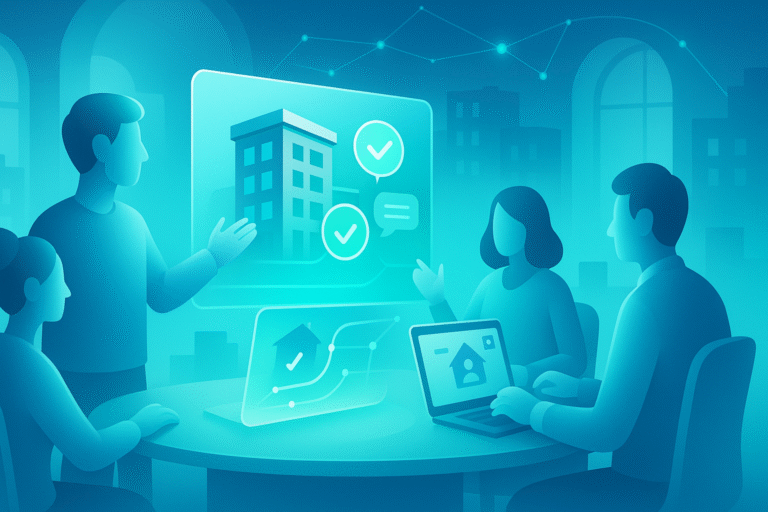
Within Concorder, your organization can create topic-based groups (e.g., Marketing, R&D, People & Culture, Sustainability), each with members, roles, and rules. Groups host proposals with clear objectives, collaborative paragraphs, attachments, and status tracking. Members comment, suggest changes, and follow the evolution of each proposal with a full revision history.
This granular collaboration — detailed in How a shared decision is born — turns scattered feedback into structured alternatives, making it easier to converge on solutions that are both reasoned and widely supported.
Embedded AI and contribution analysis
Concorder’s AI goes beyond automatic minutes. It analyzes discussions, synthesizes emerging themes, and suggests ways to clarify drafts. It detects redundancies, proposes alternative formulations, and surfaces related topics across groups. Managers can focus on strategic points while teams benefit from faster, clearer decision cycles.
Voting and virtual assemblies
Internal voting groups can be configured for single choice, multiple choice, or ranked options, with custom parameters such as quorum or qualified majority. In a virtual assembly, only mature points are put to a vote. Results are calculated instantly and displayed with summaries that are easy to read and share.
At the end, an AI-generated minute captures agenda items, attendance, outcomes, responsibilities, and deadlines. The document can be digitally signed and archived in the group, reinforcing compliance and organizational memory.
Measurable benefits for the business
Faster, more inclusive decisions
Speeding up decisions does not mean rushing them — it means eliminating waste. Companies that adopt digital deliberation reduce approval times by streamlining debate, making rules explicit, and cutting back-and-forth. When contribution is simple and visible, more people bring useful, contextual knowledge at the right time.
Trust, engagement, and retention
When people see their ideas considered, trust grows. Participation strengthens culture, reduces turnover, and helps leaders practice ethical, accountable governance. Transparent processes become a signature of leadership quality — and a magnet for talent who want to contribute, not just execute.
Sustainable governance and traceable data
Every comment, revision, and vote in Concorder is securely tracked with privacy-respecting controls. Over time, these data reveal participation patterns and bottlenecks, guiding continuous improvement. Beyond efficiency, this visibility creates a shared memory that de-risks onboarding and handovers.
For an institutional perspective on participation quality, inclusion, and impact, see the OECD’s guidance on open government and citizen participation, which aligns closely with the principles embedded in participatory corporate governance.
Comparative table: from hierarchy to collaboration
| Aspect | Traditional management | Participatory company |
|---|---|---|
| Decision flow | Top-down, low visibility | Collaborative, traceable votes and clear rules |
| Participation | Limited to command tiers | Open to teams by role or project |
| Decision memory | Manual, hard-to-find minutes | Digital AI minutes, signed and archived |
| Innovation | Slow processes, scattered ideas | Continuous idea flow, AI analysis, structured feedback |
Conclusion
Participatory companies treat people as strategic contributors, not passive executors. With Concorder, collaboration becomes a structured, well-documented process that turns ideas into shared, verifiable decisions. The result is speed with rigor, inclusion with accountability, and innovation with memory.
👉 Discover all features on Concorder.net.
Authoritative sources
- Wired Italia — AI & work: benefits, risks, and opportunities
- OECD — Open Government & Citizen Participation