
Introduction
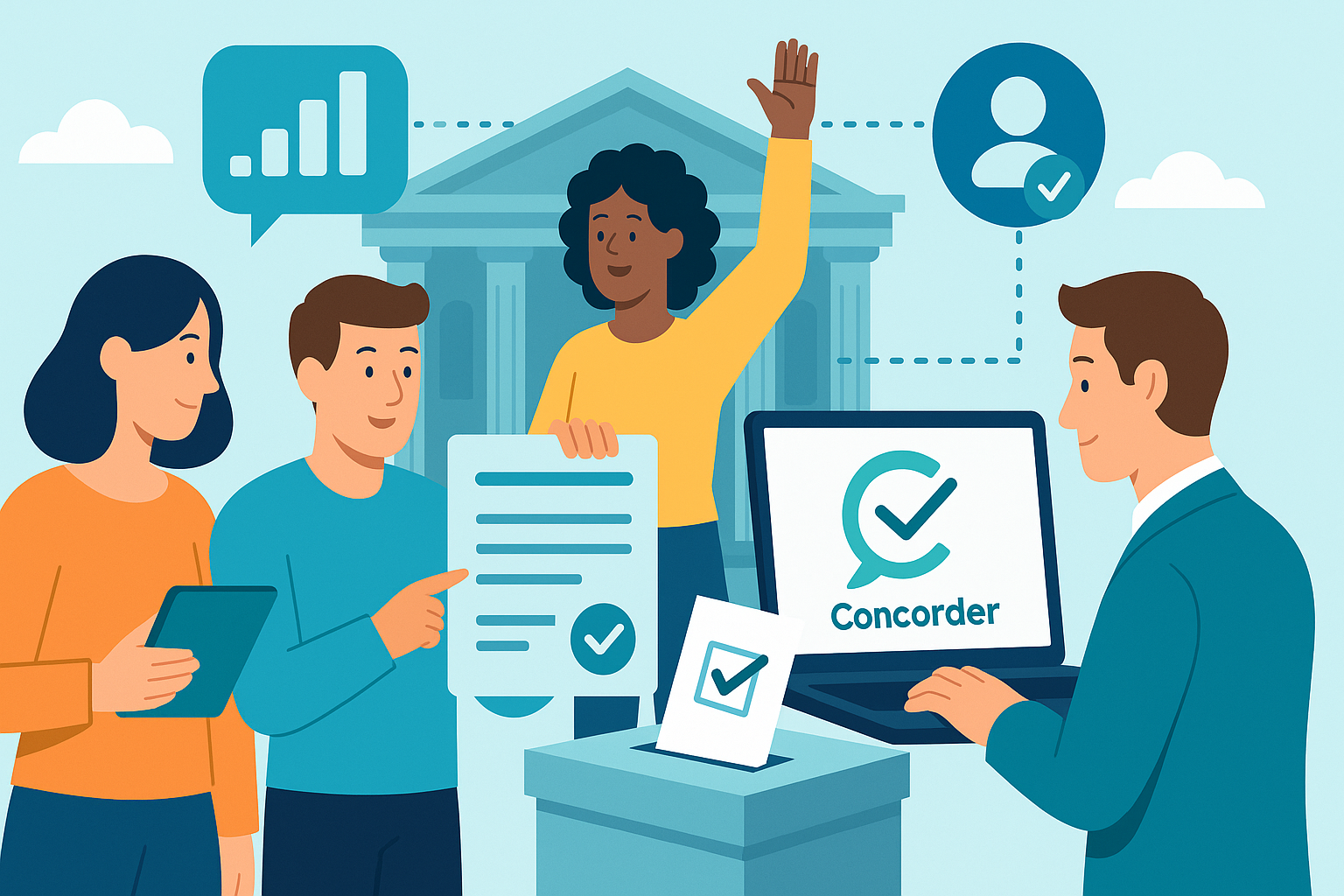
Digital transformation is reshaping how political movements organize, listen, and decide. Beyond social media broadcasting, today’s participation requires structured consultations, traceable deliberation, and credible voting. Concorder provides exactly this: a decision-making environment where proposals evolve with contributions, votes are recorded transparently, and AI generates clear minutes for accountability. And because Concorder is also a social network—with public profile pages, interests and values, contact options, and group pages with members and public proposals—it connects people and groups around ideas, not noise.
From the square to the platform: participation grows up
Contemporary political movements are hybrid: they still meet offline, but they structure discussion and decision-making online. What matters is not “putting everything on the internet,” but designing the journey: clear questions, time windows, moderation rules, voting criteria, and publication of results. For historical context and method, see The history of digital democracy: from Greek agoras to online forums, which shows how spaces and rules of debate determine the quality of outcomes.
Digital consultations: openness, method, trust
Consultations work when they are part of a clear decision cycle: proposal → contributions → deliberation → vote → follow-up. At EU level, this is visible on the Commission’s “Have Your Say” portal, where citizens and stakeholders provide structured feedback on initiatives and legislation, strengthening democratic legitimacy. International guidance—such as the OECD report on Innovative Citizen Participation and New Democratic Institutions—highlights benefits, limits, and design trade-offs, inviting movements to make rules explicit.
From social listening to structured deliberation with Concorder
Concorder is not a broadcast tool; it is an infrastructure for collaborative decision-making—and a social network that organizes people around proposals and groups. Key capabilities for movements and civic coalitions:
- Profiles and Groups (social layer): public profile pages (proposals, interests, values, contact); group pages with members and public proposals to discover and join.
- Collaborative proposals: structured texts by sections, with attachments and full edit history.
- Paragraph-level contributions: participants comment where it matters, reducing noise and ambiguity.
- Configurable digital voting: yes/no, ranked or multiple-choice, with quorum settings and traceable results.
- Virtual assemblies: gather multiple proposals in synchronous/asynchronous sessions.
- AI everywhere: not only automatic minutes—AI also assists proposal drafting, integrates and generates contributions, and supports content & comment moderation across the whole process.
- AI-generated minutes: participants, agenda points, voting results, observations, and next actions in a single, shareable record.
For governance angles and implementation patterns, see How e-governance improves participatory processes.
Quality by design: practices and standards
Movements often look for quality standards to emulate. The GovLab CrowdLaw project documents how opening law- and policy-making to public expertise can improve legitimacy and problem-solving—if processes are well integrated with institutional workflows. Together with the OECD’s comparative evidence, these references help activists and parties shape consultations that are open yet disciplined, inclusive yet focused, and—above all—actionable.
Conclusion
Digital participation is not (only) about new tools—it is about rules, roles, and responsibility. Platforms matter, but well-designed journeys matter more: choices must be understandable, verifiable, and implementable. With Concorder, movements can move from generic “listening” to documented deliberation: traceable votes, AI-assisted drafting and moderation, and minutes that turn debate into results. And because Concorder is also a social network, people and groups can discover each other, connect, and act—around proposals that lead to real change.
👉 Explore all features at www.concorder.net and design transparent, inclusive, action-oriented consultations.