

Introduction
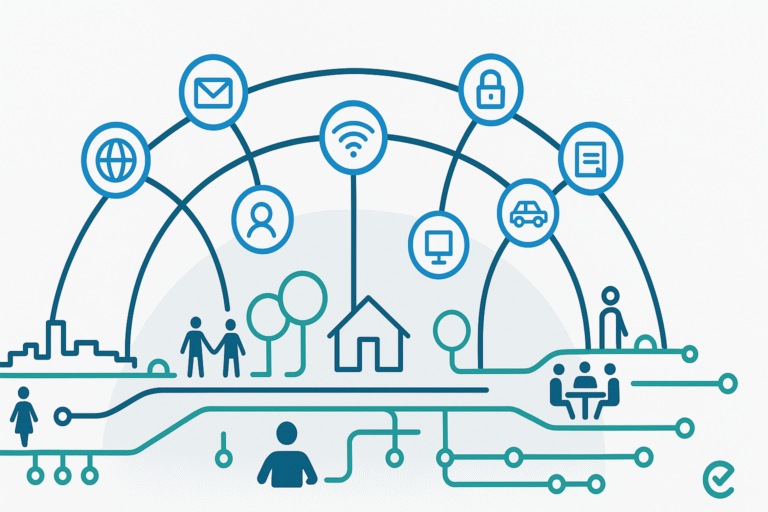
From the open squares of ancient Greece to today’s online forums, the history of democracy is also the history of the places where citizens meet to deliberate and decide together. Each era has transformed the way people participate. Today, thanks to digital technology, we are entering a new phase — one in which collaboration and collective decision-making can happen anywhere, through open and inclusive platforms like Concorder, which bring citizens’ voices back to the heart of democratic life.
1. The Agora and the birth of public debate
Democracy, as we know it, was born in ancient Greece. The agora was not only a marketplace but the civic heart of the city — a space for speech, argument and collective decision. It represented the first model of horizontal participation, where legitimacy arose from open dialogue rather than authority.
Centuries later, with the rise of the printing press, public discourse expanded. The “public sphere,” theorized by Jürgen Habermas, became the foundation of modern democracy: a space where newspapers and pamphlets amplified citizens’ voices and shaped political life. For the first time, debate was not limited to physical gatherings but became a shared, cultural force.
2. From print to mass media
Between the 19th and 20th centuries, democracy expanded through parliaments and universal suffrage, but communication remained largely one-way. Radio and television brought politics into people’s homes, but citizens were still spectators more than participants.
These were the years of grand speeches and televised debates: collective moments, yet centrally controlled. Public dialogue became more visible, but not necessarily more participatory — an early paradox of modern democracy.
3. The rise of the Internet: forums as new agoras
With the arrival of the Internet in the 1990s, the paradigm changed completely. Early online communities — newsgroups, forums and mailing lists — became the new public squares. Anyone could start a topic, make an argument, and invite others to respond. Participation became horizontal, global and asynchronous.
These online spaces were the first laboratories of digital deliberative democracy. They showed that people, when given the tools and freedom to engage, want to share ideas and contribute to the common good. At the same time, they also revealed the need for structure and moderation: without clear rules, discussions risked fragmentation, polarization and disinformation.
4. From conversation to decision: the rise of participatory platforms
In the 2010s, governments and civic organizations began to explore how to turn online conversations into structured decision-making. This marked the birth of digital participatory democracy: a new generation of platforms designed for collaboration, transparency and accountability.
Projects such as Decidim (Barcelona) and Consul (Madrid) became open-source standards for citizen participation, enabling users to draft proposals, comment, and vote on local policies. Meanwhile, The GovLab at NYU introduced the CrowdLaw concept — inviting citizens not only to vote but to help write and improve legislation.
According to the OECD and the United Nations, such tools are now considered essential pillars of modern governance. Across Europe, platforms like Concorder are contributing to this evolution — offering transparent and inclusive spaces where citizens can co-create, debate and decide together.
5. From the Agora to the Forum: continuity through change
If the ancient agora was a physical space for direct democracy, the online forum is its digital counterpart. Both share the same purpose: to enable discussion, deliberation and collective decision. What has changed is not the principle, but the medium.
| Era | Democratic Space | Key Features |
|---|---|---|
| Ancient Greece | Agora | Direct participation and community deliberation |
| Modern Era | Print media and salons | Expansion of public opinion and mediated dialogue |
| 20th Century | Radio and television | Mass communication, largely one-directional |
| Digital Era | Online forums and civic platforms | Continuous dialogue, transparent and traceable participation |
6. A new democratic culture
Digital participatory democracy does not replace representative institutions — it strengthens them. Civic platforms create new opportunities for citizens, organizations and institutions to collaborate transparently on shared decisions.
As explored in Checklist to organize a secure online voting process, secure online voting is only one element of a broader participatory framework. What truly matters is dialogue — the ability to contribute, discuss, and make informed collective choices.
Even small-scale experiences, such as those described in How to organize a valid and secure condominium meeting online, show how digital democracy can thrive in everyday contexts: from city councils to neighborhood committees, from civic projects to condominium assemblies.
Conclusion
From Athens to the digital age, democracy has always been about dialogue and shared decision-making. What changes are the tools, not the essence. Today, online forums and participatory platforms are extending the ancient spirit of the agora — creating spaces where everyone can contribute to shaping the future.
Would you like to experience digital participatory democracy in your organization?
Book a free demo of Concorder
Authoritative sources
- Stanford Encyclopedia of Philosophy – Habermas and the Public Sphere
- Decidim.org – Open platform for participatory democracy
- Consul Project – Civic participation framework
- The GovLab (NYU) – CrowdLaw Project
- OECD – Innovative Citizen Participation and New Democratic Institutions
- United Nations – E-Government Survey 2022